
Your cart
There are no more items in your cart
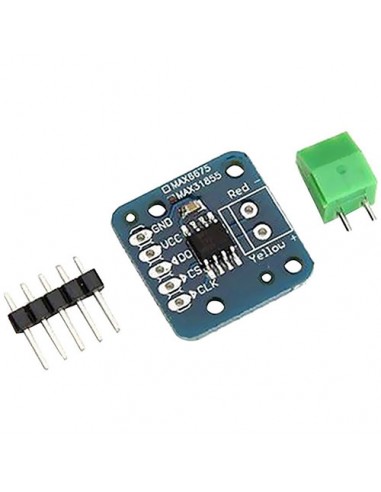



MAX6675 K-Type Thermocouple Sensor Module – High Temperature SPI Interface
The MAX6675 K-Type Thermocouple Module is a high-precision temperature sensing solution designed for measuring extreme temperatures up to 1024°C. This module uses the MAX6675 thermocouple-to-digital converter to accurately read data from a K-type thermocouple and output it via an SPI interface, making it ideal for Arduino, ESP32, and other microcontroller-based systems.
With built-in cold junction compensation and 12-bit digital output, this module ensures stable and reliable temperature readings in demanding environments.
Key Features
- High Temperature Measurement – Supports readings up to 1024°C
- K-Type Thermocouple Interface – Widely used and highly durable sensor type
- 12-bit Digital Output – Accurate and stable readings
- Cold Junction Compensation – Improves measurement accuracy
- SPI Communication – Easy integration with microcontrollers
- Wide Voltage Range – Works with both 3.3V and 5V systems
- Compact Design – Ideal for embedded and space-limited projects
Technical Specifications
- Sensor Type: K-Type Thermocouple (not included unless specified)
- Converter IC: MAX6675
- Temperature Range: 0°C to 1024°C
- Resolution: 0.25°C
- Output Interface: SPI (Serial Peripheral Interface)
- Operating Voltage: 3.0V – 5.5V DC
- Working Current: ~50mA
- Operating Temperature (Module): -20°C to +85°C
- Module Size: 20.3 x 20.3 x 5mm
Applications
- Industrial temperature monitoring
- Kilns, furnaces, and ovens
- 3D printer hotend temperature sensing
- HVAC and thermal systems
- DIY and Arduino projects
- Educational electronics kits
Important Notes
- Requires a K-type thermocouple probe (sold separately if not included)
- The MAX6675 is not compatible with MAX31855 – ensure correct code/library is used
- Designed for high-temperature measurement applications
Why Choose the MAX6675 Module?
The MAX6675 module offers a reliable and accurate solution for high-temperature sensing, making it perfect for both industrial and DIY applications. Its simple SPI interface, wide voltage compatibility, and precise readings make it a popular choice for engineers, makers, and students.
